

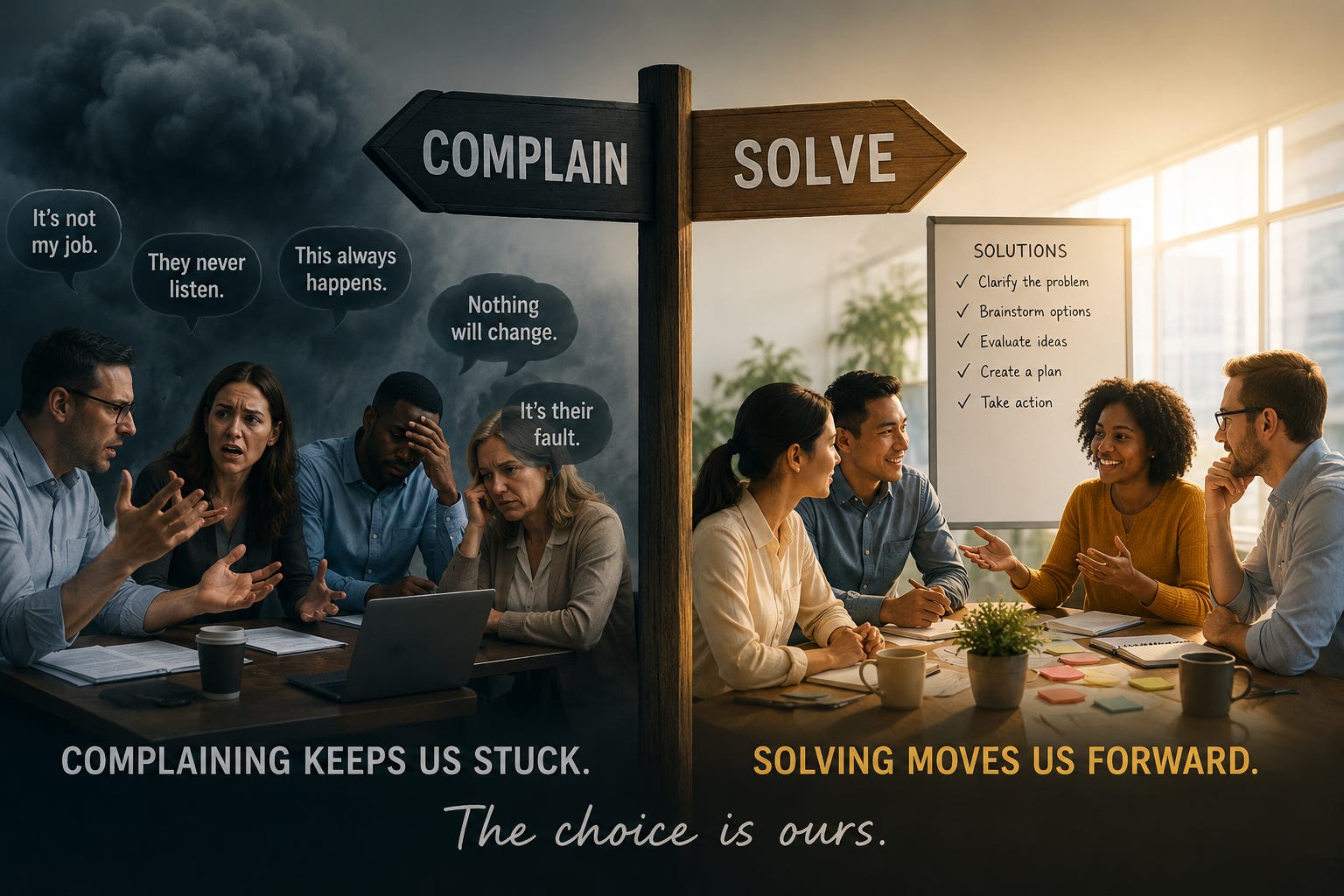
There are moments in leadership where you suddenly realize the conversation is no longer about solving the problem. It is about feeding the frustration surrounding it.
I have sat in those rooms. Honestly, I have participated in them.
A meeting or watercooler conversation starts with a legitimate concern. Someone is overwhelmed. A process is broken. Expectations were unclear. The problems are real. At some point, the conversation stops moving forward and starts circling. We build on each other’s frustration, the emotional energy rises, and without anyone intending it, the focus shifts from solving the issue to validating why it feels impossible.
What has fascinated me over the years is how quickly the atmosphere changes when someone asks a different question:
“How would you solve the problem?”
It is almost physical. The body language changes. The emotional intensity lowers. People stop rehearsing frustration and start thinking critically. It is almost as if you can see the gears in someone’s brain slow down, stop, and begin turning in another direction.
The older I get, the more convinced I am that this shift, from perpetuating the complaint to participating in the solution, may be one of the most important differences between teams that stay stuck and teams that actually move forward.
Complaining Keeps People in Box 1
In The Three-Box Solution, Vijay Govindarajan describes Box 1 as the space organizations occupy when they remain heavily focused on managing the present and preserving existing patterns.
Box 1 is necessary. Organizations need operational stability.
But problems arise when teams become emotionally trapped there.
A culture dominated by complaint cycles tends to reinforce:
Reactive behavior
Defensive communication
Short-term emotional release
Preservation of existing dysfunction
People become experts at describing problems without moving toward solutions.
Over time, the organization can unintentionally normalize helplessness.
This is particularly dangerous in healthcare and value-based care environments where complexity is constant, and uncertainty is unavoidable. If every challenge becomes another opportunity to reinforce frustration rather than move toward action, teams remain stuck in operational survival mode.
The work becomes about reacting rather than improving.
Eventually, that exhaustion becomes cultural.
The Science Behind the Shift
Research in organizational psychology and neuroscience supports this phenomenon.
Studies on cognitive reappraisal and solution-focused thinking suggest that shifting attention from rumination to problem-solving changes both emotional regulation and cognitive processing. Research has shown that persistent rumination increases stress activation and reduces cognitive flexibility, while solution-oriented thinking activates more adaptive executive functioning processes associated with planning, emotional regulation, and decision-making.
Research on psychological safety and constructive conflict also demonstrates that teams perform better when individuals feel safe identifying problems and are encouraged to contribute to solutions, rather than remaining in cycles of blame or emotional escalation.
This does not mean people should suppress frustration or avoid difficult conversations.
Healthy organizations absolutely need healthy conflict, but conflict is fundamentally different from chronic complaint culture.
Healthy conflict:
Seeks clarity
Challenges assumptions
Surfaces risk
Moves toward improvement
Complaint culture:
Reinforces helplessness
Centers emotion without action
Personalizes problems
Drains organizational energy
One creates movement. The other creates stagnation.
Why Leaders Must Pay Attention
One of the hardest truths about organizational culture is that leaders often underestimate how their behavior sets the tone for what becomes normalized.
If leaders consistently engage in complaint-based conversations without redirecting toward ownership and solutions, teams will naturally mirror that behavior.
Culture is not created primarily through mission statements or leadership presentations.
It is created in everyday interactions:
How meetings are run
How problems are discussed
How conflict is managed
How accountability is reinforced
What behaviors receive attention and validation
Leaders cannot expect teams to adopt a problem-solving culture if leadership itself remains emotionally reactive, overly political, or trapped in cycles of frustration.
That work starts at the top, and candidly, it requires self-awareness.
Most of us, myself included, can get pulled into the complaint cycle if we are not intentional about stepping out of it.
Sometimes Teams Need a Reset
If a team has been operating in a chronic cycle of frustration, blame, or reactive communication for a long period of time, simply asking people to “be more positive” is unlikely to work.
Often, the team needs a reset that may involve:
Structured team development work
Leadership coaching
Facilitated conflict resolution
Organizational development support
Bringing in independent experts to help rebuild healthier communication dynamics
External, neutral facilitation can help teams step outside entrenched patterns and create space for more productive dialogue.
Even then, sustainable change will not happen unless leaders actively participate in the process themselves.
Organizations sponsor team-building activities, but they cannot outsource cultural accountability.
Leaders must participate and model:
Curiosity instead of defensiveness
Accountability instead of blame
Emotional regulation instead of escalation
Solution-focused thinking instead of chronic reactionary behavior
Otherwise, teams quickly recognize the disconnect between what leaders say they value and what they actually reinforce.
Why This Matters
My experience comes primarily from healthcare and value-based care environments, where operational pressure can easily create reactive cultures, but this dynamic exists everywhere: in organizations, in families, in friendships, in communities, and even within ourselves.
Many of us spend enormous energy reacting to problems while investing far less energy into thoughtfully addressing them. Over time, that cycle becomes exhausting.
It keeps people stuck putting out fires rather than building systems that prevent them.
It reinforces what I discussed previously in Breaking the Hamster Wheel, the exhausting cycle of constant reactionary behavior that creates movement without meaningful progress.
At some point, individuals and organizations have to consciously decide:
Do we want to remain emotionally attached to the problem, or do we want to participate in building solutions?
Those are very different mindsets.
A Brief Note on Healthy Conflict
One important clarification: moving away from a complaint culture does not mean avoiding disagreement. In fact, healthy conflict is essential for strong organizations.
Innovation, accountability, and improvement all require people who are willing to challenge assumptions, ask difficult questions, and surface concerns honestly.
The difference is whether conflict moves the organization forward or simply amplifies emotional friction.
That distinction deserves a much deeper conversation in its own right, and I will expand on it in a future article.
Final Reflections
The most powerful cultural shifts are often not dramatic.
Sometimes they begin with a single question.
“How would you solve the problem?”
It is a deceptively simple shift, but it changes the direction of the conversation and, perhaps more importantly, the direction of responsibility.
Teams and outcomes improve when people move from passive frustration to active participation.
The same is often true in life.
Resources and Further Reading
D’Zurilla, T. J., & Nezu, A. M. (2007). Problem-Solving Therapy: A Positive Approach to Clinical Intervention. Springer Publishing.
Edmondson, A. (1999). Psychological safety and learning behavior in work teams. Administrative Science Quarterly, 44(2), 350–383.
https://web.mit.edu/curhan/www/docs/Articles/15341_Readings/Group_Performance/Edmondson%20Psychological%20safety.pdf
Edmondson, A. C. (2018). The Fearless Organization: Creating Psychological Safety in the Workplace for Learning, Innovation, and Growth. Wiley.
Govindarajan, V. (2016). The Three-Box Solution: A Strategy for Leading Innovation. Harvard Business Review Press.
Gross, J. J. (1998). The emerging field of emotion regulation: An integrative review. Review of General Psychology, 2(3), 271–299. https://emotion.wisc.edu/wp-content/uploads/sites/1353/2021/11/Gross-1998-The-Emerging-Field-of-Emotion-Regulation-An-Integrative-Review.pdf
Nolen-Hoeksema, S., Wisco, B. E., & Lyubomirsky, S. (2008). Rethinking rumination. Perspectives on Psychological Science, 3(5), 400–424. https://drsonja.net/wp-content/themes/drsonja/papers/NWL2008.pdf
Stone, D., Patton, B., & Heen, S. (2010). Difficult Conversations: How to Discuss What Matters Most. Penguin Books.
Talkington, C. (2026). Breaking the hamster wheel. Substack. https://candicetalkington.substack.com/p/breaking-the-hamster-wheel